Home › Plumbers › Sewer line repair & replacement
Houston's aging sewer lines — a hidden, expensive problem
Plenty of Houston homes are running on the original sewer line the builder put in decades ago. In older neighborhoods that means cast iron, which lasts about 50–70 years before corrosion does it in — and a lot of pre-1980 Houston housing stock is right at that edge. Cast iron corrodes from the inside out, leaving a rough, scaly interior that snags debris and causes the recurring clogs homeowners keep paying to clear, until the pipe finally cracks or channels through.
Then there's the soil. Houston's expansive clay swells and shrinks with the seasons, shifting the ground around the line. That movement misaligns joints and creates "bellies" — low spots where waste pools and blockages form. Combine corroded cast iron with moving clay and tree roots seeking moisture at the joints, and you have the three forces behind most Houston sewer replacements.
Signs your sewer line — not just one drain — is the problem:
- Multiple drains slow or back up at the same time.
- Gurgling toilets, or the tub backing up when the washer drains.
- Sewage smell in the yard or near floor drains.
- Recurring clogs that come back within weeks of being cleared.
- Soggy patches or unusually green strips in the yard following the line's path.
- You own a pre-1980 home and have never had the line camera-inspected.
Step one is always a camera inspection
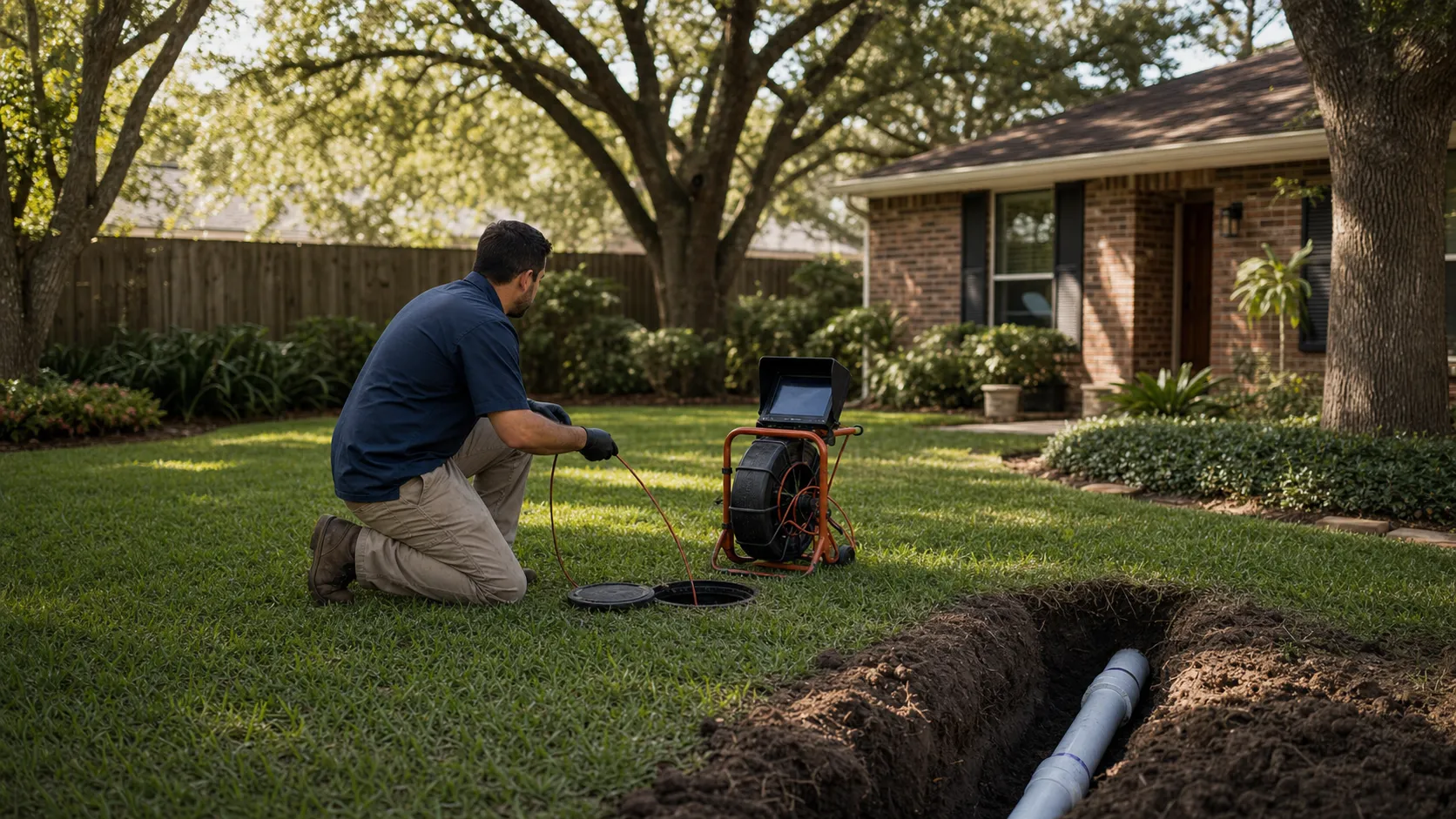
No honest sewer quote happens without one. A camera run down the line shows exactly what's wrong, where, and how deep — a single break, root intrusion, a belly, or a fully collapsed section. That diagnosis is what determines whether you need a $1,500 spot repair or a $9,000 replacement, and whether trenchless is even possible. A contractor who quotes a replacement without putting a camera in the line is guessing with your money.
Methods — trenchless vs traditional
Trenchless — pipe bursting & lining
Pipe bursting pulls a new pipe through the old one while breaking the old pipe apart — ideal for damaged cast iron or clay. Cured-in-place lining (CIPP) inserts a resin sleeve that hardens into a new pipe inside the old one. Both work through one or two small access pits instead of trenching the whole run, so your driveway, patio, and mature trees survive. Often finished in a day.
Traditional dig-and-replace
Excavate the line, remove the old pipe, lay new PVC, backfill, and restore the surface. Sometimes unavoidable — severe collapses, bellies that need re-grading for proper slope, or lines too far gone to host a trenchless pipe. More disruptive and slower, but the right call when the line can't support trenchless.
What it costs in Houston — 2026
| Scope | Typical Houston range (2026) |
|---|---|
| Camera inspection (diagnostic) | $250–$850 |
| Spot repair — single break, accessible | $900–$3,500 |
| Trenchless (pipe bursting / lining), typical residential | $4,000–$12,000 |
| Full dig-and-replace | $3,000–$25,000 |
| Per linear foot — traditional | $30–$200/ft |
| Per linear foot — trenchless | $60–$250/ft |
These are typical Houston ranges from published 2026 cost guides (Angi, Repipe Solutions) — not a quote; your matched plumber sets the price after a camera inspection. The camera fee is often credited toward the repair. The wide replacement range is real — a short, shallow yard run is a different job than a long line under a slab or driveway.
What drives the price
- Length and depth of the run — longer and deeper means more labor and more spoil to remove.
- Under-slab vs yard — a line running beneath the foundation is far more involved than one in open yard. Under-slab failures often overlap with slab leak territory.
- Access and restoration — driveways, patios, mature landscaping, and city sidewalk all add restoration cost (and are the strongest argument for trenchless).
- Method — trenchless costs more per foot but can cost far less once you add back the demolition and restoration that traditional digging requires.
- Permits and locates — city permitting and utility locating are part of any legitimate job.
Recurring clogs first? Read this before you replace
If your only symptom is a line that keeps clogging, don't jump straight to replacement. Sometimes a thorough hydro jetting and camera inspection clears years of grease and root buildup and buys real time — and the camera tells you honestly whether the pipe underneath is sound or genuinely failing. Replacement is the answer when the pipe itself is gone, not when it just needs a real cleaning.
How we vet Houston plumbers
Sewer replacement is one of the priciest jobs a homeowner faces — exactly where vetting earns its keep. Before any plumber receives a single lead from us, we confirm:
- Active Texas Responsible Master Plumber (RMP) license — verified against the Texas State Board of Plumbing Examiners (TSBPE) register.
- Current general liability insurance — checked, not just claimed.
- Camera-first diagnosis — they show you the footage before quoting a replacement.
- A review history of 4 stars or better across Google and the BBB, with no unresolved TSBPE complaints.
- Houston service coverage — works our cast-iron-and-clay neighborhoods every week, local to your ZIP.
Quotes from partner pros are honored — and you'll see the camera footage and a written scope before committing to a number this size.
Frequently asked
How much does sewer line repair or replacement cost in Houston?
A spot repair on a single accessible break runs $900–$3,500. A full sewer line replacement runs $3,000–$25,000 depending on length, depth, and method, with most Houston residential jobs landing in the $3,000–$7,000 range. Trenchless methods (pipe bursting or lining) typically run $4,000–$12,000. By the foot, traditional dig-and-replace is roughly $30–$200 per linear foot and trenchless $60–$250 — the spread depends on depth, whether the line runs under the slab, and how much surface has to be restored afterward.
Trenchless or traditional dig-and-replace — which is better?
Trenchless (pipe bursting or cured-in-place lining) replaces or relines the pipe through one or two small access points instead of trenching the whole run. It's faster, cleaner, and avoids tearing up driveways, mature landscaping, and patios — often finished in a day. Traditional dig-and-replace is sometimes unavoidable: severe collapses, bad bellies that need re-grading, or lines too damaged to host a new pipe. A camera inspection tells the plumber which methods are even possible; the honest ones present both with real numbers.
How long do cast iron sewer lines last in Houston?
Cast iron sewer lines last about 50–70 years before corrosion causes failure, and many Houston homes built before 1980 are at or past that mark. Cast iron corrodes from the inside out, leaving a rough interior that snags debris and causes recurring clogs, then cracks and channels through entirely. Add Houston's shifting clay soil — which stresses joints and creates bellies — and pre-1980 cast iron is the single most common sewer-replacement driver in the city.
Why does a camera inspection come before any quote?
Because no one can honestly price a sewer repair they haven't seen. A camera run shows exactly what's wrong — a single break, root intrusion, a belly, or a fully collapsed section — and where it is and how deep. That determines whether you need a spot repair or a full replacement, and whether trenchless is even an option. Any contractor quoting a sewer replacement without a camera inspection is guessing, and you'll usually pay for that guess.
Does homeowners insurance cover sewer line replacement?
Usually not under a standard policy — sewer lines typically fail from age, corrosion, and root intrusion, which insurers treat as wear-and-tear rather than a sudden accident. Some homeowners carry a separate service-line endorsement (often $30–$60/year) that does cover the buried sewer and water lines on their property; if you have it, it can substantially offset a replacement. Check your policy for that endorsement before you assume you're not covered.
How long does a sewer line job take?
A spot repair is often a one-day job. Trenchless replacement or lining is frequently completed in a single day for a typical residential run, since there's minimal excavation. Traditional dig-and-replace runs one to several days depending on length, depth, and whether the line is under the slab or the driveway — plus restoration time to put the surface back. Permitting and locating utilities can add a day or two on the front end.
How do I know if I need a repair or a full replacement?
It comes down to what the camera shows. One isolated break in otherwise-sound pipe is a spot repair. But if the camera reveals widespread corrosion, multiple breaks, recurring root intrusion at many joints, or a line that's already in cast iron past its lifespan, repeatedly patching it is throwing money away — full replacement (often trenchless) ends the cycle. A good plumber shows you the camera footage so you can see the difference for yourself.
Backed-up or broken sewer line?
Drop your number and ZIP at the top of this page. A vetted Houston plumber calls you back within 30 minutes during business hours, runs a camera inspection, and gives you honest repair-vs-replace options — trenchless and traditional — in writing. Serving Houston and the surrounding neighborhoods.
Request a callback