Home › Electricians › Whole-home rewire
Most Houston "rewire" calls don't actually need a full rewire
A full whole-home rewire is the largest residential electrical project a homeowner ever pays for. It's also the right answer in fewer cases than the internet implies. Many Houston homes get sold a $20,000 rewire when the actual fix was $1,500 of aluminum-pigtailing or a panel swap. Other homes patch and patch around a wiring system that should have been replaced ten years ago, until a claim — or a non-renewal letter — forces the issue.
This guide is the licensed-electrician version of the conversation: what triggers a real rewire in a Houston home, what triggers a remediation-only fix, and how to tell the two apart before you sign anything.
The Houston-specific drivers — aluminum and knob-and-tube
Aluminum branch wiring (1965–1973 builds)
Aluminum branch wiring was used in roughly 2 million US homes during a copper-price spike from 1965 to about 1973. Houston was hit harder than most metros — Sharpstown, large parts of Spring Branch, Memorial-area tracts built in that window, older Bellaire, parts of Meyerland, and many Westbury homes were wired this way. The conductor itself isn't the problem; the connections at every outlet, switch, and panel termination are.
Aluminum expands and contracts about twice as much as copper under the same heat load. Over decades of cycling — and Houston attics see a lot of cycling — the connections at brass-screw devices loosen. A loose connection arcs and heats. The CPSC has documented that homes with aluminum branch wiring are 55 times more likely to have at least one connection at "fire hazard conditions" than homes wired with copper. That's the actual risk metric.
Two paths from here, both legal, both common:
- Remediation (COPALUM or AlumiConn pigtailing): a licensed electrician opens every device on every aluminum circuit, splices a short copper "pigtail" onto the aluminum conductor with an approved connector, and lands the copper at the device. Typical Houston cost: $25–$60 per device, plus a panel-side fix. A 1,900 sqft 1970 Sharpstown home with ~60 devices runs $2,500–$5,000 done right. This is the answer for most aluminum-wired homes where the conductors themselves are intact.
- Full rewire: remove the aluminum entirely and pull new copper branch circuits. The answer when conductors are damaged (rodent, water, prior amateur work), when the panel is also at end-of-life, when an insurance carrier is forcing it, or when the homeowner is doing a deep renovation anyway and the drywall is open.
Knob-and-tube (pre-1950 inner-loop homes)
Knob-and-tube wiring — open conductors run through ceramic insulators and tubes inside walls — was standard residential practice through the 1940s. Inner-Loop Houston neighborhoods built before WWII still have some: parts of the Heights, Montrose, Riverside Terrace, Eastwood, Idylwood, Old Sixth Ward. Original knob-and-tube has no ground conductor, was sized for 1930s electrical loads, and — critically — was designed to dissipate heat through open air.
When that wiring later got buried under blown-in attic insulation (something almost every Houston home has had done at least once since 1980), the heat-dissipation assumption breaks. National Electrical Code has prohibited insulation contact with active knob-and-tube since the late 1980s. That single fact — insulated over — is why almost every active knob-and-tube circuit in a Houston home needs to come out, not be patched.
Practical reality: pure original knob-and-tube is uncommon now. Most pre-war Houston homes have had partial rewires done in the 1960s–80s with the new circuits stubbed in alongside the old. You may have knob-and-tube in two ceiling-light circuits and the rest modern. A diagnostic visit will scope what's actually live.
When the wiring is "fine" but the panel is the problem
The third common Houston scenario isn't really a rewire question — it's a panel question that gets mislabeled. A home with copper branch wiring but a Federal Pacific, Zinsco, or Challenger panel doesn't need a rewire; it needs a panel upgrade. Don't let a contractor bundle a $4,000 panel job into a $20,000 rewire if the branch circuits are sound. The same logic applies if you're planning a whole-home generator on top of original wiring — bundling the rewire + panel + generator into one permit cycle saves real money over doing them in three separate trips.
What triggers an insurance-forced rewire
In Houston, insurance is now the biggest single driver of whole-home rewires. Carriers have tightened underwriting since 2020 and most will non-renew — or refuse to bind a new policy — on these conditions:
- Any active knob-and-tube wiring (zero tolerance from most carriers since 2022).
- Aluminum branch wiring without documented pigtail remediation (a growing list, including most non-admitted carriers now).
- Federal Pacific Stab-Lok, Zinsco, Sylvania, or Challenger panels — a panel issue, not strictly wiring, but often grouped.
- Visible 60-amp service (still found in some 1940s–50s Houston bungalows).
- "Improvised" wiring discovered at point-of-sale inspection — extension cords used as permanent wiring, multi-wire connections in non-junction boxes.
The pattern: a roof claim or routine inspection triggers a carrier walk-through, the carrier flags the wiring, you get a 30–60 day cure letter, and you have to either rewire or move to a non-admitted/surplus-lines carrier at materially higher premium. Texas FAIR Plan is sometimes the bridge during work; it's not a long-term answer.
What a Houston rewire actually involves — room by room
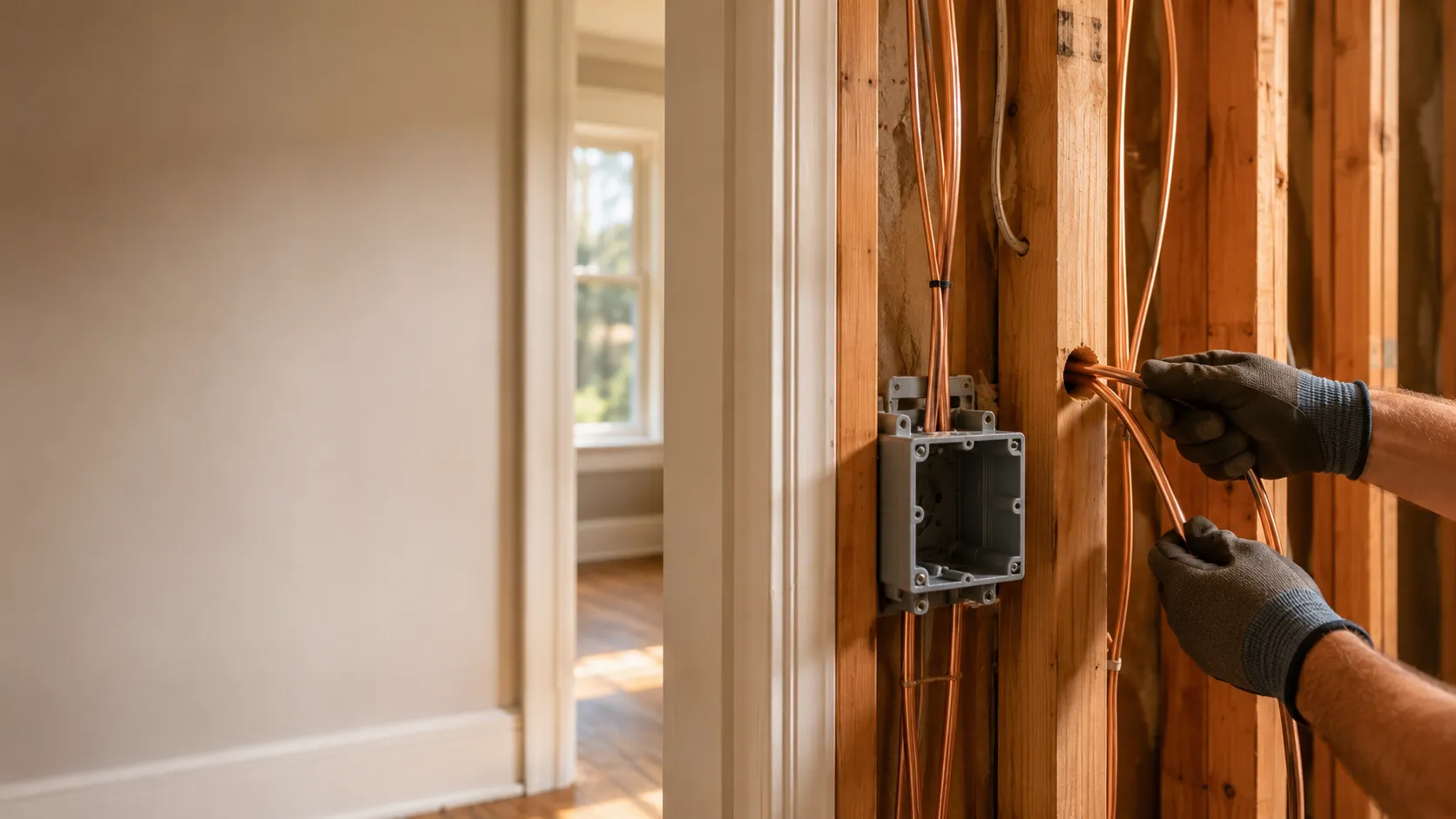
A whole-home rewire is mostly attic, crawlspace, and box-cutting work. Here's what a 7–14 working-day rewire on a typical 1,900 sqft Houston single-story actually looks like:
-
Day 1–2 — Walkthrough, permit, demo prep
Crew maps every existing circuit, marks new device locations (often adding outlets to bring rooms to current code — most pre-1980 Houston bedrooms have 2 outlets when code calls for 4–6), and pulls the City permit. Furniture pulled to room centers; floors and walkways protected with rosin paper.
-
Day 3–8 — Pulling new wire by zone
Power to the zone is killed at the panel each morning, restored at end of day. Crew works the attic — much of a Houston rewire happens crawling above the drywall, in 130°F summer attic heat that adds cost and is part of why local crews charge what they do. New copper runs drop down wall cavities to switch and outlet boxes. Drywall is cut where it has to be (typical: each device box, plus occasional 6×6" access squares high on a wall).
-
Day 8–10 — Panel swap and service work
The panel comes out and a new 200-amp panel goes in, with the new branch circuits landed properly with AFCI/GFCI protection per current code. If the service drop or mast needs work, CenterPoint is coordinated — that's typically a 1-day disconnect/reconnect. Bring chargers for laptops; plan a hotel or a stay with friends if it's August.
-
Day 11 — Rough-in inspection
City inspector verifies the rough work before walls close. This is non-negotiable; an electrician who skips this is creating a problem for the eventual home sale.
-
Day 12–14 — Drywall patch, devices, trim, final inspection
Patching crew (usually a subcontractor included in the quote) closes openings, tapes, textures to match. Devices and cover plates installed. Smoke and CO detectors hardwired and interconnected per code. Final inspection. Sign-off. Permit closed.
What it costs in Houston — 2026
| Scope | Typical Houston range (2026) |
|---|---|
| Aluminum-wire pigtailing only (remediation, ~60 devices) | $2,500–$5,000 |
| Partial rewire (e.g. knob-and-tube replacement in 2–4 circuits only) | $3,500–$8,000 |
| Whole-home rewire — 1,200–1,600 sqft single-story | $9,000–$16,000 |
| Whole-home rewire — 1,800–2,400 sqft single-story | $12,000–$22,000 |
| Whole-home rewire — 2,400–3,500 sqft, two-story | $22,000–$40,000 |
| Add: 200-amp panel upgrade bundled in | + $1,600–$4,000 |
| Add: new service mast / CenterPoint coordination | + $800–$2,500 |
| Add: drywall patch + texture match (typical scope) | Included in most quotes |
| City permit + inspections | $75–$300 |
These are typical Houston-area ranges compiled from published 2026 cost guides (Angi, Handoff) — a typical range, not a quote. Houston Service Hub doesn't set or quote prices; your matched electrician gives the binding number after seeing the walls and panel. Anything materially under usually leaves out the permit or drywall patching; anything over usually means pier-and-beam access issues, asbestos texture that needs encapsulation, or a custom-home wire run.
Five questions to ask the electrician before you sign
- "Is this scope a true full rewire or can we remediate?" A good pro will tell you when pigtailing aluminum or replacing just the panel solves the actual underlying problem at a fraction of the cost. If they push straight to full rewire without diagnosing, get a second opinion.
- "Is drywall patch and texture included, and to what standard?" The honest answer is "patched and textured to match, paint is on you." Watch for quotes that leave the drywall as an open line item — that's where surprise bills appear.
- "Are you pulling a City of Houston permit, and will I get the closed permit at the end?" Permit number on the quote. Closed-permit confirmation at the end. Both are required for a clean record on the home.
- "What's the inspection schedule?" A real rewire has two: rough-in (before walls close) and final (with panel energized). One-inspection rewires are skipping the rough.
- "What happens if you find something inside the walls?" Active rodent damage, prior amateur splices in inaccessible spots, asbestos texture. Get the change-order policy in writing before work starts — typical fair terms are notify-and-photograph before billing, with a per-hour rate stated in advance.
How we vet Houston electricians
Before any electrician receives a single lead from us, we confirm:
- Active Texas TDLR electrical license — TECL number on file and verified against the state register.
- Current general liability insurance — checked, not just claimed.
- A review history of 4 stars or better across Google and the BBB.
- No unresolved TDLR complaints — clean standing with the state board.
- Houston rewire experience — partner crews that have actually pulled whole-home rewires in Houston housing stock, not a generalist who'll subcontract it out.
Quotes from partner pros are honored. If a number changes after a wall opens, it's because the wall hid something the original walkthrough couldn't see — not bait pricing. You'll see the photo, the change-order line, and the revised total before any extra work continues.
Frequently asked
How do I know if my Houston home actually needs a full rewire versus spot repairs?
Three triggers usually justify a full rewire: (1) confirmed aluminum branch wiring throughout (typical of 1965–1973 Houston builds) with multiple loose-connection symptoms across rooms — warm switches, flickering, repeated tripping; (2) any active knob-and-tube in a home that's been insulated since (a fire-code issue); (3) an insurance non-renewal or homebuyer-inspection callout that names the wiring. One bad outlet or one tripping circuit doesn't mean rewire — get a licensed diagnostic first.
What does a whole-home rewire actually cost in Houston?
For a typical 1,800–2,400 sqft Houston single-story, $12,000–$22,000 is the realistic 2026 range, depending on access (slab vs pier-and-beam, attic clearance), how much drywall has to open, and whether the panel and service get upgraded at the same time. Two-story or 3,000+ sqft homes commonly run $22,000–$40,000+. Always bundle the panel upgrade if the existing panel is original to the wiring — separating them wastes money.
Can we stay in the house during a rewire?
Usually yes, for most of it. A licensed crew works one zone at a time, kills power to that zone for the workday, and restores it by evening. Plan for one or two full no-power days when the panel itself is swapped and at the final inspection. Most Houston homeowners stay in the house for 7–14 working days of an attic-and-wall rewire; some choose a hotel for the panel-swap days, especially in summer heat.
Will the walls all have to come down?
No — but expect controlled drywall cuts. A good crew uses attic and crawlspace access where possible, fishes new wire down wall cavities, and only cuts drywall where it has to (typically at switch and outlet boxes, plus occasional small access squares). Patching and texturing is normally included in the quote; matching paint is usually on you.
Is aluminum branch wiring actually dangerous, or can I just leave it?
Aluminum branch wiring is legal and many Houston homes still have it. The risk isn't the metal itself — it's the connections at outlets, switches, and the panel, which loosen over decades because aluminum expands and contracts differently than the brass screws that hold it. Loose connections generate heat. The CPSC has linked aluminum-wire connections to a measurably higher fire rate than copper. If you're not ready for a full rewire, the minimum-acceptable interim is COPALUM or AlumiConn pigtailing at every device — typically $25–$60 per device, done by a licensed pro.
Will my homeowner's insurance pay for a rewire?
Standard homeowner's insurance does not pay for wiring upgrades — it pays for fire damage. What insurance will do is non-renew or refuse to write a policy on a home with active knob-and-tube or undisclosed aluminum branch wiring. That's the more common path: the carrier letter forces the rewire, not a claim. Texas FAIR Plan can sometimes cover homes mid-remediation but it's expensive. Get the rewire quote first, then call your agent.
Do I need a permit, and does Houston inspect every rewire?
Yes to both. A whole-home rewire is permitted electrical work in the City of Houston (and surrounding jurisdictions). Your licensed electrician pulls the permit, schedules the rough-in inspection (before walls close back up) and the final inspection (with the panel energized). Skipping permits is a homeowner trap: your insurer can deny a future claim, and it'll surface in any sale. The permit fee ($75–$300 typically) is rolled into the quote.
How long does a Houston whole-home rewire take?
Plan on 2–4 weeks for a typical single-story (1,800–2,400 sqft). The crew is on-site 7–14 working days; the rest is inspection windows, drywall patching, and texture-cure time. Larger or two-story homes run 4–8 weeks. Anyone quoting you a 3-day whole-home rewire is either skipping inspections, skipping drywall, or both — walk.
Trying to figure out if your Houston home actually needs a rewire?
Drop your number and ZIP at the top of this page. A vetted Houston electrician calls you back within 30 minutes during business hours, walks the home, and gives you a straight answer — rewire, remediation, or panel-only — with a firm number in writing before any work starts.
Request a callback