Home › Electricians › Whole-home generators
In Houston, the question isn't if the power goes out — it's how long
Hurricane Beryl knocked out power for over 2 million Houston-area homes in July 2024, and a meaningful share were still dark a full week later. Hurricane Ike, Hurricane Harvey, the 2021 winter freeze, and a string of bad spring derechos all did the same thing — multi-day outages with a freezer full of food, no AC in 95-degree heat, and elderly relatives on home medical equipment. A whole-home standby generator is the only honest answer for a Houston home that can't ride out a 3–7 day outage on a portable inverter and a few extension cords.
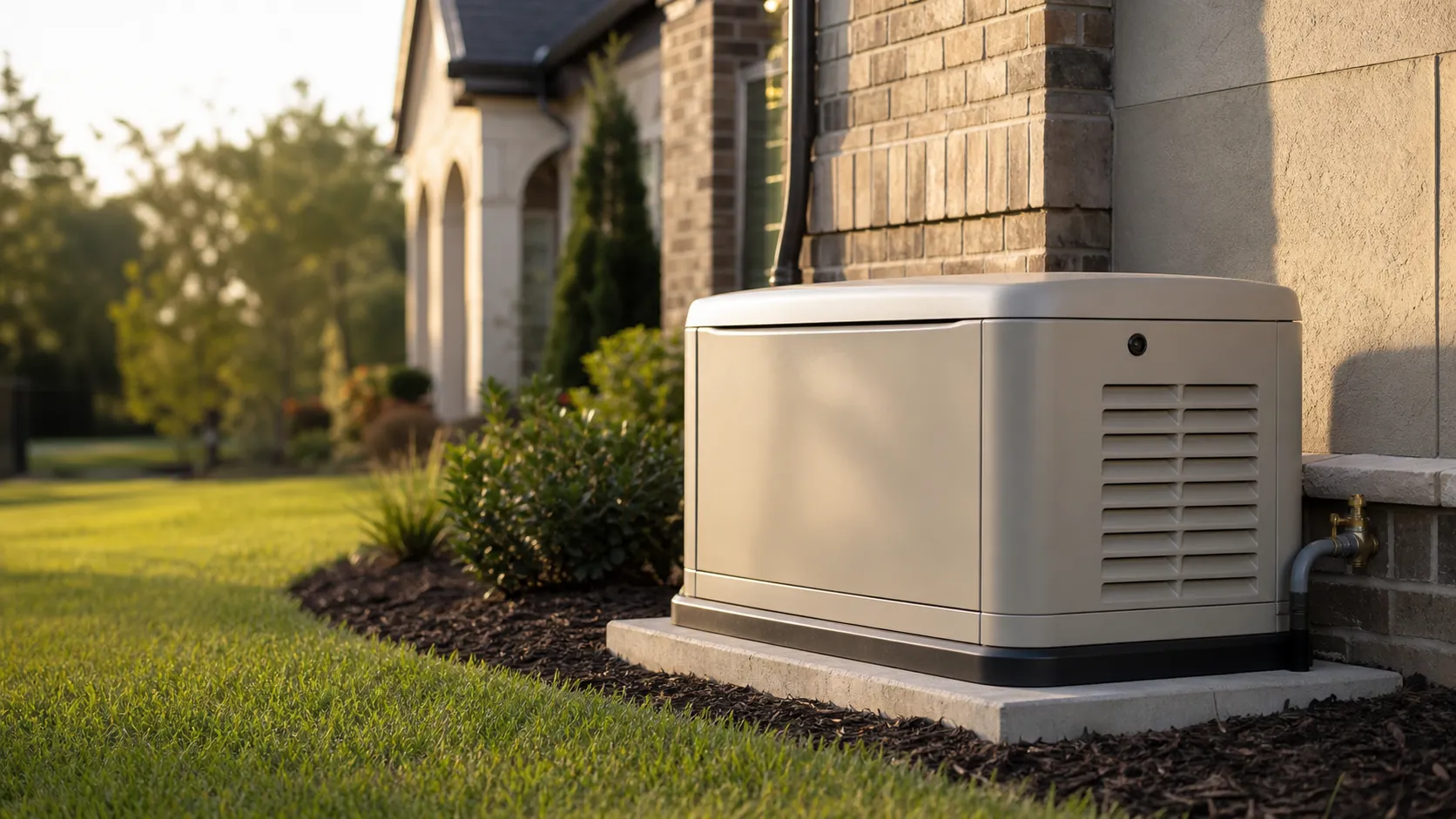
This guide walks the real decisions: sizing by what you actually need to keep running, natural gas vs propane (Houston has a clear default here), how the automatic transfer switch works, where the unit can sit on your lot, permit reality, and the 2026 cost ranges Houston installers actually quote.
Sizing — start with critical loads, not square footage
The myth: "Bigger house, bigger generator." The reality: a 4,500-sqft Houston home with one heat pump and gas-everything-else can run on 18 kW; a 2,200-sqft all-electric townhome with two AC units can need 22–26 kW. Sizing follows what plugs into your panel, not your floor plan.
A licensed installer runs a load calc the same way an EV-charger or panel-upgrade pro would: add up nameplate amps on the loads you want to run during an outage, derate for diversity (you don't run the dryer, oven, and pool pump at the exact same second), and pick the next standard generator size up. Two paths Houston homeowners typically choose between:
- Whole-home backup. Generator + ATS covers the entire main panel. Every circuit runs during an outage — both ACs, both ovens, the EV charger if you have one. Requires sizing for the home's true peak load (usually 22–48 kW for Houston housing stock).
- Managed-load whole-home backup. Generator + ATS + load-shedding module covers the entire panel but the smart module sheds non-critical loads (oven, dryer, EV charger, pool) during peaks. Lets a 22 kW unit comfortably back up a home that would otherwise demand 30+ kW. Often the sweet spot for 3,000–4,500 sqft Houston homes with one EV.
A "critical-loads-only" sub-panel install (10–14 kW backing up a small list of must-have circuits) is the cheaper path but increasingly unpopular post-Beryl — homeowners who lived through 110-degree heat indices without their second AC tend to size up the next time.
Natural gas vs propane — Houston's clear default
Houston is mostly natural-gas country. If CenterPoint Energy gas already serves your home (most of Inside the Loop, Bellaire, West U, Memorial, most of Sugar Land, most of The Woodlands, most established Katy and Pearland tracts), natural gas is almost always the right call.
Natural gas — the default
Pros: the fuel line is already on your property; no tank to permit, install, or hide; runs continuously for as long as the gas main is up; cheaper per kWh produced than propane; the gas grid stayed up through Beryl and Ike for the vast majority of Houston customers.
Cons: theoretically dependent on a utility that could be interrupted (rare in modern Houston outages, but not impossible during a major flood or transmission failure); may require gas-meter upsizing for the new generator load ($1,200–$3,500 added to the install).
Propane — the storage-independence play
Pros: totally independent of utility infrastructure during an outage; useful in pockets without gas service (parts of Cypress, north Spring, far Fort Bend, rural Brazoria); a full 500-gallon tank typically runs a 22 kW generator for 6–10 days at moderate load.
Cons: $2,500–$5,500 for the tank install (above-ground or buried); refill logistics during a region-wide hurricane event get ugly fast (every propane truck within 200 miles is booked); higher fuel cost per kWh produced; tank takes up yard space and triggers HOA approval in many Houston subdivisions.
Transfer switches — automatic, managed, manual
The transfer switch is the device that disconnects your home from the utility and connects it to the generator (and back again when utility power returns). Three flavors Houston installers use:
| Switch type | What it does | Typical cost (installed) |
|---|---|---|
| Automatic (ATS) — service-rated | Whole-panel backup, fully automatic transfer in 10–30 sec, includes utility disconnect | $1,800–$3,800 |
| Automatic + load shed module | Whole-panel backup with smart shedding of high-draw circuits to support smaller generator | $2,400–$4,800 |
| Manual | Homeowner flips a switch when power goes out; backs up only pre-wired emergency circuits | $800–$1,800 |
For a true whole-home install, the ATS (with or without load shed) is the only sane choice — manual transfer switches assume you're home, awake, and able to operate the panel during an outage, which fails the test the moment you're at work or asleep.
Panel and service — what often goes in alongside
A generator install is one of the most common triggers for a panel upgrade in Houston. A few patterns worth knowing about before the quote arrives:
- Older 100-amp panels usually can't accommodate a service-rated ATS, and the load calc rarely allows it. A 200-amp panel upgrade commonly goes in first.
- If you also have aging branch wiring (cloth-insulated, aluminum, knob-and-tube), the panel + generator combo is the natural time to bundle a whole-home rewire — one permit cycle, one inspection trip, fewer drywall openings revisited.
- If you're also adding a Level 2 EV charger, do the load math for both at once. A 22 kW generator + a 48A EV charger on the same panel needs careful load-shed configuration so the EV doesn't crash the generator the first time you charge during an outage. See the EV charger guide for the load-calc piece.
- Flood-zone homes (anything in 100-year or 500-year floodplain in Houston) have additional generator-pad elevation requirements — typically 12 inches above base flood elevation. This is usually a $400–$1,200 add for elevated pad and conduit.
What a Houston whole-home generator install costs — 2026
| Scope | Typical Houston range (2026) |
|---|---|
| 14 kW air-cooled natural gas, ATS, standard install | $8,500–$12,500 |
| 22 kW air-cooled natural gas, ATS, standard install | $11,000–$17,000 |
| 26 kW air-cooled natural gas, ATS + load shed | $14,500–$20,500 |
| 36–48 kW liquid-cooled, ATS, large home / all-electric | $22,000–$38,000+ |
| Add: gas meter upsize (CenterPoint) | + $1,200–$3,500 |
| Add: 500-gallon propane tank install (if no gas service) | + $2,500–$5,500 |
| Add: 200-amp panel upgrade if required first | + $1,500–$3,800 |
| Add: flood-zone elevated pad | + $400–$1,200 |
| City permits (electrical + gas + mechanical) | $200–$650 |
| Annual maintenance contract (typical) | $300–$550/year |
These are typical Houston-area ranges compiled from published 2026 cost guides (PSL Technology, HomeGuide) — a typical range, not a quote. Houston Service Hub doesn't set or quote prices; your matched installer gives the binding number after a load calc and site check. Quotes materially below this band usually leave out the gas-line work, the ATS, or both — common bait on big-box generator "deals."
Permits, inspections, and the CenterPoint piece
A whole-home generator install in Houston touches three permit categories, all pulled by the installer: electrical (panel tie-in, ATS), gas (new fuel line from meter to generator), and mechanical/building (pad, location, setbacks). Inspections normally happen at rough-in (before the pad is buried and the conduit is closed up) and final (after commissioning and a load test).
CenterPoint Energy is involved twice. First, on the gas side if the meter needs upsizing — that's an application + scheduled meter swap, usually 2–6 weeks lead time and worse during hurricane season. Second, on the electric side if the ATS install requires a temporary disconnect to swap in the service-rated switch — typically a 1–3 hour outage window scheduled at install time, no different from a panel upgrade's CenterPoint coord.
Surrounding jurisdictions (Bellaire, West U, Sugar Land, Pearland, Katy, The Woodlands, plus unincorporated Harris and Fort Bend) each have their own permit windows and setback rules. The right installer knows your ZIP's jurisdiction and pulls the right paperwork without you chasing it.
Five questions to ask before you sign the quote
- "Did you run a load calc, and what generator size did it call for?" If they sized off square footage alone, you're either being oversold or undersized. The calc should look at your actual panel and the loads you want backed up.
- "Does my gas meter need upsizing, and is that in the quote?" The single most common missing line on cheap generator quotes. A 22 kW unit typically needs a meter capable of 250–325 cubic feet/hour — the standard residential meter often isn't. If they don't know, they haven't checked.
- "Is the ATS service-rated, and is it whole-panel or a sub-panel of critical loads?" Whole-panel + service-rated ATS is the modern standard for a true whole-home install. A "critical loads sub-panel" is a different product at a different price — you should know which you're buying.
- "Are all three permits pulled — electrical, gas, mechanical?" All three should be on the quote, with the installer's license number. Skipping any one creates an insurance problem the day a claim happens.
- "What's the maintenance contract and warranty on the install labor?" Generators are mechanical. Year-1 manufacturer warranty is standard; the labor warranty on the install (the part most likely to be the problem) varies widely. 5 years on labor is generous; 2 is typical; less is cheap.
How we vet Houston generator installers
Generator installs sit at the intersection of three trades — electrical, gas, and concrete — which is exactly where unlicensed and half-licensed operators show up after every hurricane. Before any installer receives a single lead from us, we confirm:
- Active Texas TDLR electrical license — TECL number on file and verified against the state register.
- Gas-fitter credential or licensed gas subcontractor — for the fuel-line side of the install.
- Current general liability insurance — checked, not just claimed.
- Manufacturer certification — Generac, Kohler, Cummins, or Briggs factory-authorized service. Matters for warranty claims.
- A review history of 4 stars or better across Google and the BBB, with Houston-specific install reviews — not relocated reviews from another market.
- Houston hurricane-season install history — installers who've supported customers through Beryl, Harvey, or Ike know what the real failure modes look like.
Quotes from partner pros are honored. If a number changes after the site walkthrough — usually because the gas meter needs upsizing or the panel can't accommodate a service-rated ATS — you'll see the photo, the change-order line, and the revised total before any extra work continues.
Frequently asked
How big a generator do I actually need for my Houston home?
Sizing is driven by what you want to run, not by square footage alone. A 2,500-sqft Houston home with two AC units, electric water heater, and modern appliances typically needs 22–26 kW to run everything at once. If you only need 'essentials' (one AC zone, fridge, lights, well/pool pump, internet), 14–18 kW does the job. The electrician runs a load calc against your panel, asks which circuits matter to you during an outage, and sizes from there. Going too small means brownouts and tripped generator breakers in August; going too big wastes $3,000–$6,000 on capacity you'll never use.
Natural gas or propane — which makes sense in Houston?
Natural gas if your home is already served by CenterPoint Energy gas (most inside Loop 610 and most established suburbs are) — it's cheaper, runs continuously without refilling, and the line is already on your property. Propane if you're in a pocket without gas service (parts of Cypress, far north Spring, rural Fort Bend), or if you want fuel storage independent of utility infrastructure during a hurricane. Propane costs more per kWh produced and requires a 500–1,000 gallon tank ($2,500–$5,500 installed), but it doesn't depend on a gas main that could theoretically be shut off during a major storm. Most Houston installs are natural gas.
What does a whole-home generator actually cost installed in Houston?
Equipment + install for a 22 kW air-cooled natural-gas generator with automatic transfer switch typically runs $11,000–$17,000 in Houston. Larger liquid-cooled units (26–48 kW) for big homes or all-electric loads run $18,000–$32,000+. Add $1,200–$3,500 if your gas meter needs upsizing for the new load, $2,500–$5,500 for a propane tank if going that route, and $1,600–$4,000 if a panel upgrade is required first. Permits, gas-line work, and CenterPoint coordination are usually rolled into the installer's quote.
How long does the install take from contract to running?
Plan on 4–8 weeks total in Houston, mostly waiting on gas-meter upsizing if needed and CenterPoint scheduling. On-site work is typically 2–4 days: pad pour and cure (1 day), generator set + transfer switch install (1–2 days), gas-line tie-in and inspection (½ day), commissioning and test under load (½ day). Hurricane-season demand stretches the calendar — book in March–May to be running before the June 1 season start, not in October when every Houston installer is 6 weeks out.
Will the generator actually start automatically when the power goes out?
Yes — that's the entire point of an automatic transfer switch (ATS). When utility power drops, the ATS detects it within seconds, signals the generator to start, waits 10–30 seconds for the generator to come up to stable voltage and frequency, then transfers your home's panel onto generator power. When utility power comes back, it reverses the sequence. The generator also runs a weekly self-test (typically Wednesday mid-day, ~10 minutes) to verify it'll start when needed. Manual transfer switches exist and are cheaper, but they require you to be home and flip a switch — pointless for a home backup during a multi-day outage.
Does a generator install require a permit in Houston?
Yes — three of them, usually pulled together by the installer. Electrical permit for the transfer switch and panel tie-in (City of Houston or your jurisdiction), gas permit for the new fuel line, and a mechanical/building permit for the pad and the generator's location (setback requirements from windows, doors, and property lines). Surrounding cities (Bellaire, West U, Sugar Land, Pearland, Katy, The Woodlands) each have their own permitting and setback rules — a Houston installer who works your ZIP weekly handles this without surprise.
Where can the generator actually sit on my property?
Code requires minimum clearances — typically 5 feet from any window or door that opens, 5 feet from a property line, and at least 18 inches of clearance on the sides and rear for service access. Exhaust must not blow directly toward a neighbor's window or an HVAC fresh-air intake. In Houston, the most common location is along the side of the house near the gas meter on a concrete or composite pad. Some HOAs (River Oaks, Memorial, parts of The Woodlands) have additional screening or location requirements — confirm with your HOA before the pad goes in.
How often does it need maintenance, and what does that cost?
Annual service is the standard: oil + filter change, spark plug check, battery test, transfer-switch test, valve adjustment on higher-hour units. Houston installers typically offer service contracts at $300–$550/year for an annual visit, with priority scheduling during hurricane season. Skipping maintenance is the #1 reason a generator fails to start during an outage — old oil, dead start battery, or a fouled plug. Treat it like an HVAC service: once a year, on the calendar, ideally in spring before storm season.
Ready to put a whole-home generator on your Houston house before the next storm?
Drop your number and ZIP at the top of this page. A vetted Houston installer calls you back within 30 minutes during business hours, runs the load calc, checks your gas meter and panel, and gives you a firm number in writing — including whether anything else has to go in first.
Request a callback